A university is a small city with a single address and a dozen different legal identities inside it. The academic buildings, the residence halls operated by a private partner, the food court franchise, the arena run by an events company, the construction site behind the library and the sidewalk at the property line are all governed differently.
That matters enormously when someone falls, because the answer to who is responsible in Houston depends less on where the fall felt like it happened than on which entity actually controlled the surface.
Texas Sorts Visitors Into Categories First
Before anything else, Texas premises law asks what the injured person was doing there.
Invitee, licensee, trespasser
Someone present for the mutual benefit of both parties, such as a student, an employee or a ticketed attendee, is generally an invitee and is owed the highest ordinary duty: reasonable care to make safe or warn of conditions the owner knew or should have known about.
A social guest is typically a licensee, owed a narrower duty concerning conditions actually known to the owner. A trespasser is owed very little beyond refraining from willful injury.
The same puddle produces different outcomes depending on which category applies, which is why the first question in these cases is rarely about the puddle.
Notice remains the battleground
For an invitee, the claim generally requires showing the owner knew of the condition or that it existed long enough that reasonable inspection should have found it.
Time is therefore the contested fact in almost every case. Inspection logs, cleaning schedules and camera footage establish it, and all three have short retention cycles.
Public and Private Campuses Are Not the Same Problem
This is the distinction that catches people, and it can end a claim before it starts.
A public university is a governmental unit
Texas public institutions are governmental units, and claims against them run through the Texas Tort Claims Act, which waives immunity only in defined circumstances and attaches strict notice requirements.
Those notice deadlines are short; they are measured in months rather than years, and missing one is generally fatal to the claim regardless of its merits. A private university has no such protection and is handled as an ordinary premises case.
Anyone injured on a public campus needs to establish which category the institution falls into immediately, because the clock is different and it is unforgiving.
Accessibility standards shape the duty
Public entities are covered by Title II of the Americans with Disabilities Act, and the Department of Justice’s Title II primer explains the obligations that apply to state and local government programs, services and facilities.
The physical requirements sit in the 2010 ADA Standards for Accessible Design, which specify ramp slopes, handrail dimensions, stair geometry, landing sizes and surface characteristics.
A stair or ramp built outside those specifications is not automatically negligence. It is, however, an objective standard to measure against, which is far more persuasive than an argument that a surface felt unsafe.
The Construction Exception Nobody Expects
Campuses are perpetually under construction, and Texas treats injuries to construction workers very differently from injuries to students walking past.
Under Chapter 95 of the Civil Practice and Remedies Code, a property owner is not liable for personal injury or death to a contractor, subcontractor or their employee who constructs, repairs, renovates or modifies an improvement to real property, unless both conditions are met.
The owner must have exercised or retained some control over the manner in which the work was performed, beyond merely ordering work to start or stop or inspecting progress, and the owner must have had actual knowledge of the danger and failed to adequately warn.
Both, not either. It is a demanding standard and it defeats a great many claims that would otherwise succeed.
Houston weather is a recurring factor
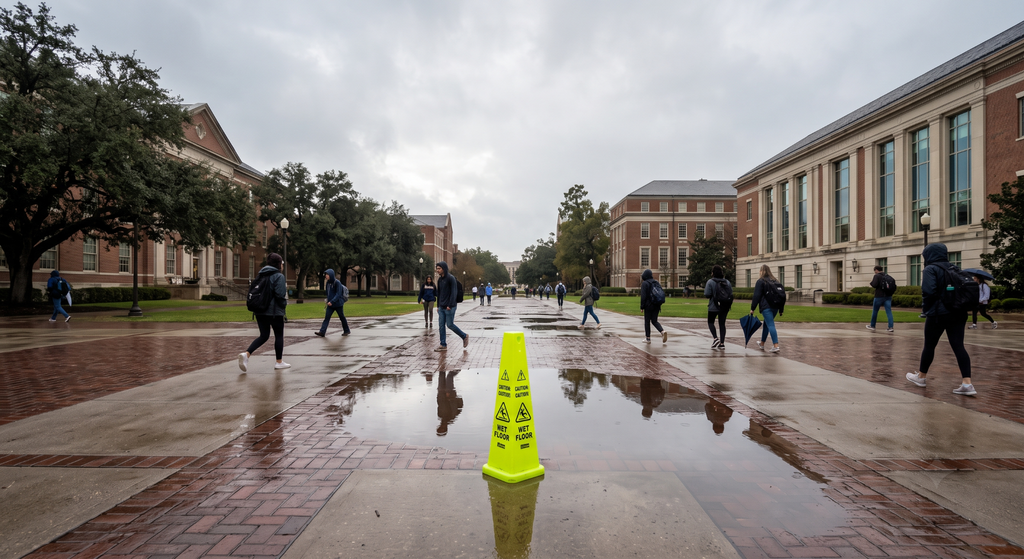
Sudden heavy rain turns polished lobby floors into a hazard within minutes, and the adequacy of matting and warning signage at entrances becomes the whole case.
The rare freeze is worse, because a city with little winter infrastructure treats almost nothing, and untreated steps and walkways stay dangerous for days.
Off-Campus Is Its Own Map
The surrounding blocks are where a large share of student falls actually happen.
Apartment complexes and landlords
Stairwell lighting, handrails, walkway drainage and parking lot surfaces generate most of these. A written maintenance request that went unanswered is the strongest evidence available, which is why complaints should always be made in writing rather than mentioned in the leasing office.
Sidewalks, bars and retail
Municipal sidewalk claims involve governmental notice requirements again. Bars and restaurants are ordinary premises cases, though the most common scenario involves a spill on a crowded floor, where establishing how long it was there is genuinely difficult without footage.
What to do the same day
Report it to the entity that controls the space and get an incident report number. Photograph the condition before it is cleaned or repaired, including whatever caused it. Get names and numbers from witnesses before they disperse, and seek medical attention promptly rather than waiting to see whether it settles.
According to personal injury lawyer Shaun M. Serelson, a Partner and Managing Attorney at RTRLAW whose practice includes premises liability claims across Texas and Florida, the entity that controls a walkway is frequently not the one whose name is on the building, and identifying it correctly in the first weeks determines whether notice was given to the right party in time. That is the usual reason people consult a Houston slip and fall lawyer before filing anything themselves.
